|
Cassette Tapes of the 1988 Congress
Sides one and two
(30 minutes each)
Some differences from Proceedings
1a Introductions
John Ralph
(Managing Director CRA)
Corazon C.Aquino - President of Philippines
(delivered by Philippines Secretary of Trade & Industry)
Congress Dinner:12/05/88.
1b
Sen. John Button - Australian
Minister for Industry Technology and Commerce
Luncheon Address: 13/05/88
2a
Teresa Nieva,
Secretary General of Congress
John Ralph,
V. Jayme
Chairman,
Asian Congress Council
Jaime Cardinal L. Sin
Morning Session 13/05/88
2b
Morning Session continued
3a
Dr. Frans Seda
General Chairman, National Association of Textile Producers,
Manufacturers and Exporters, Indonesia
and
Mr.Brian Healey
Chief Executive, Nicololas Kiwi, Pty.Ltd
Morning Session 13/05/88
3b
Morning Session continued and
Questions
4a
Mr. Bob White AO,
Director, Westpac Banking Corporation and
Mr. Will Bailey
Group Chief Executive of the ANZ Banking Group and.
Mr Tomohiro Ishiguro
General Manager Bank of Tokyo, Melbourne
Afternoon Session One
4b
3rd World Debt Discussion
Afternoon Session continued
5a
3rd World Debt Discussion Then
Mr Barry Counsel
Chairman and Managing Director Florsheim Australia
2nd Afternoon Session
5b
Continuation, and
Karam Bedi
Representative of BATA India
Afternoon Session.
6a
Continuation and
Mr Kevin Luscombe
Chairman, Thai Dairy Industries, Bangkok
V.Jayme
Summaries
Afternoon Session
Saturday Morning started 14/05/88
6b
Continuation and
Mr Dante Santos
Chairman, Philippine Airlines, Philippines
Mr Simon Lin
Associate Vice President, ACER International Corporation, Taiwan
7a
V.Jayme
Workshop Reports
2, 1, 3,
Luncheon.
7b
Workshop Reports
4, 5, 6, 7, 8
8a
Workshop Reports Continued
8, 9, 10
Consensus Discussion
8b
Conclusion
| |
|
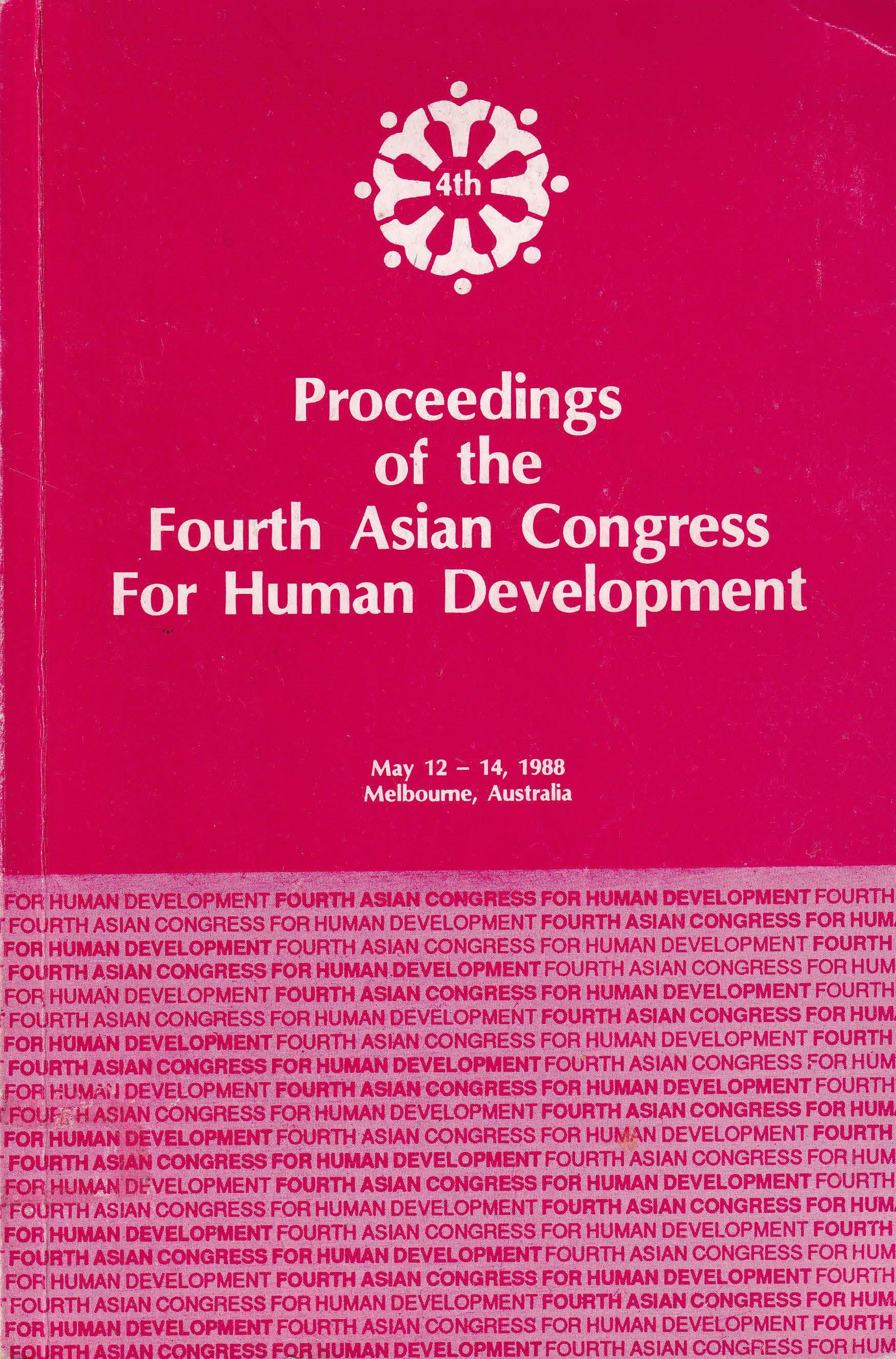
Proceedings
of the
Fourth Asian Congress
For Human Development
May 12-14, 1988
Melbourne, Australia
|
Proceedings:
Part One,
Major addresses pi-37
Proceedings:
Part Two, The Human Face of Regional Business p38-86
Proceedings:
Part Three, Continuing the Asian Drama p87-112
Proceedings:
Part Four, Workshops and Conclusion p113-237
| |
What is UNIAPAC?
|
The year of 1988 is a long time ago when looking back from the year of 1921. It is thirty-three years - a whole
lifespan in the view of a large proportion of the Asian population including Australia. Yet there is value in looking back
at the visions and hopes of the people of that time.
The Fourth Asian Congress For Human Development was spear-headed by an accountant
called John Roseman who believed that world development lay in the hands of business people. John had worked with
Catholic agencies, such as Melbourne Overseas Mission, which was providing welfare payments to people and groups in Asian
countries around Australia. Yet he insisted that if development was to go ahead in these countries, business people
must be involved.
In his efforts to awaken business to this role, John linked in with Canon Lawrie Styles of the then Inter-Church Trade and
Industry Mission (ITIM) and they formed a "Business Executives Group". (ITIM had been providing industrial chaplains to
business since the start of the 1960's.) John also found out about and contacted an organisation called
UNIAPAC.
UNIAPAC, a global organisation, dates back to the time of
Rerum Novarum (1891), a landmark Catholic social justice document.
UNIAPAC was likely to have put John into contact with a business movement in the
Philippines which had gained momentum since the toppling of the corrupt government of President Marcos in 1986. Some of the
Filipino people involved with UNIAPAC and the 4th Asian Congress could give first hand accounts of the "people revolution"
in the Philippines when over one million people took to the streets.
From the basis of the "Business Executives Group" in Melbourne, the proposal was formed to run a Fourth Asian Congress for Human
Development. Of special help to John in following through this proposal was M.A.Teresa F. Nieva who worked
from the office of Caritas in Manila. (Caritas is a worldwide, Catholic-based organisation in over 200 countries
which helps "the poorest of the poor". It dates back to 1897.) Officially,
Teresa F. Nieva, working from the Manila Caritas office, was the "Secretary General, Asian Business Congress for Human Development".
Of special support to John in his efforts to "do something" about business, morality and development, was Mr Barry
Counsel. Mr Counsel was Chairman and Managing Director of Florsheim Australia Ltd (a Shoe Company). In the proposed
Fourth Asian Congress for Human Development he was to become Chairman of the Australia Organizing Committee.
Of special "delight" to John and Barry was the acceptance by Mr. John Ralph to be Chairman of the Hosting Committee
of the proposed Congress. John Ralph was a Director of BHP Billiton and he had other "high-level" roles as well.
When the Congress did take place Mr Ralph said in his welcome address
We may have a vision for development. Translating it successfully and appropriately into
|
action is something on which we all need to share our experiences and views. (Proceedings p.15).
In the years after the Fourth Asian Congress for Human Development (1988), there continued to be some momentum of sustaining a missionary
outreach to business. Some people attended the next Asian
Congress a couple of years later (Thailand 1990). Also some people continued to meet in Melbourne and they initiated
a series of "business-persons" breakfasts which were supported by the ArchDiocese.
After Archbishop Pell took on the role of Archbishop in Melbourne 1996, he held a large, public meeting and business was invited.
To an observer
this appeared to be an attempt to "kick off" a structural outreach to business. However, by that time, in the
mid-nineties, there were revelations emerging about the child abuse scandals which had been covered up by Church
authorities. At that particular meeting there was a public challenge made about the qualifications and ability of the
Catholic Church to talk about (any sort of) morality. Something however that did carry through around that time
was that the Australian Catholic University (Melbourne) set up a Department relating to business. It was under the name of
John Ralph and his wife. At the university now (2021), a business department still exists. One hopes that within the
limits of academic subjects, the topic of business ethics is being dealt with.
In the meantime the nature of ITIM's industry chaplaincy had began to shift and diminish.
From my own perspective in the 1990's (Michelle Nailon, editor of the Proceedings), there needed to be some sort
of "program" which could be used by business. This would help people towards on-going reflection about the place of business
in society and the need to continually upgrade business ethics. In fact I have been working on such a "program" ever
since (cf. www.realitysearch.com.au). However at the time,
in the continuing group, other people did not necessarily agree my view, even though I believe they have since developed
very good programs themseves.
One of the key elements about a stagnation (?) in the missionary outreach to business that John Roseman had attempted to
set in motion, was the failure (on my own part) to realise that Teresa Nieva, a main supporter of the 4th Asian
Congress in Melbourne, was herself based from the Caritas Office in Manila. In the early 1990's when it
seemed there needed to be an appropriate base for the Australian momentum to continue, Caritas did exist in Melbourne.
However it was not set up as Caritas Australia until 1996. I could be wrong, but I doubt (in June 2021),
they have ever seen the connection between what John was doing and their own role.
In the meantime, thirty plus years later, it seems that momentum in business outreach continues on in Manila.
There is to be a 27th
UNIAPACWorld Congress to be held in Manila in 2023.
|
|
|
 Proceedings